Q&A
What is the 'Power Couple' concept? Why did TaiPower Company (TPC) propose this concept? Is it an original creation of TPC?
The core concept of Power Couple is to place industries with high electricity demand (such as AI and semiconductor industries) near power plants with diverse power combinations (renewable energy, energy storage systems, and gas-fired power plants), and match electricity demand with electricity supply. This allows industries to obtain stable low-carbon electricity nearby, reducing power supply costs, improving power efficiency, increasing grid resilience and stability, and avoiding congestion of the existing grid due to industrial electricity consumption, thus achieving a win-win situation for both electricity supply and demand.
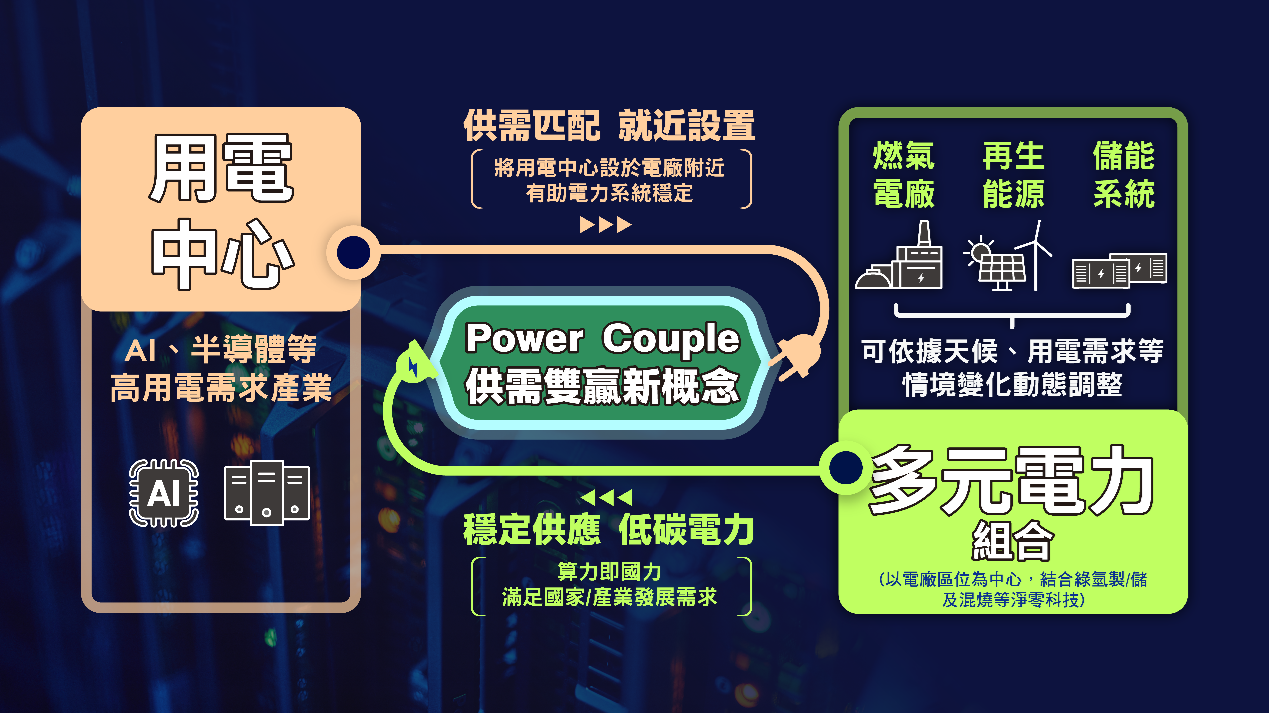
Taking AI data centers as an example, their electricity consumption patterns differ significantly from those of typical residential buildings, commercial offices, and traditional factories. However, compared to large factories, their size is much smaller. If built in densely populated metropolitan areas, they can easily lead to excessively high local electricity density, posing a significant challenge to the existing power grid. To effectively manage this type of electricity consumption, various countries have successively formulated regulations and supporting measures. The United States and many European countries, considering both energy efficiency and carbon emissions, have established review standards and regional restrictions for the establishment of data centers. In November 2025, Taiwan amended three subsidiary laws of the Energy Management Act, including the review of energy use authorization statements for newly built (or expanded) data centers exceeding 5MW.
Northern Taiwan's power grid is experiencing rapid load growth, but power construction is often delayed due to differing local opinions. To address this rapidly increasing demand, TaiPower Company (TPC), referencing international practices, is guiding energy-intensive industries such as AIDC (AI Data Center) to prioritize relocation to power-rich areas in central and southern Taiwan, suspending power applications for large data centers exceeding 5MW north of Taoyuan. By adopting the concept of co-location between industry and power supply, and effectively matching supply and demand, power transmission losses can be reduced, and grid risks can be mitigated.
Proper allocation of power resources is crucial for AI development. Achieving equilibrium through adjustments on both the supply and demand sides minimizes overall costs and maximizes development efficiency. Synchronizing industry site selection with power supply construction will establish an optimal balance between computing power and electricity, propelling the development of Taiwan's AI industry.
The concept of Power Couple is not unique to TPC. A February 2025 RMI report proposed that in the US, directly pairing large-scale electricity demand (e.g., AI data centers) with newly built renewable energy sources (wind, solar, and energy storage) near existing natural gas power plants, utilizing existing grid connection points, allows businesses to obtain low-carbon electricity more quickly without compromising grid stability or the public's electricity costs. This is a key strategic tool for the US to win the global AI race.
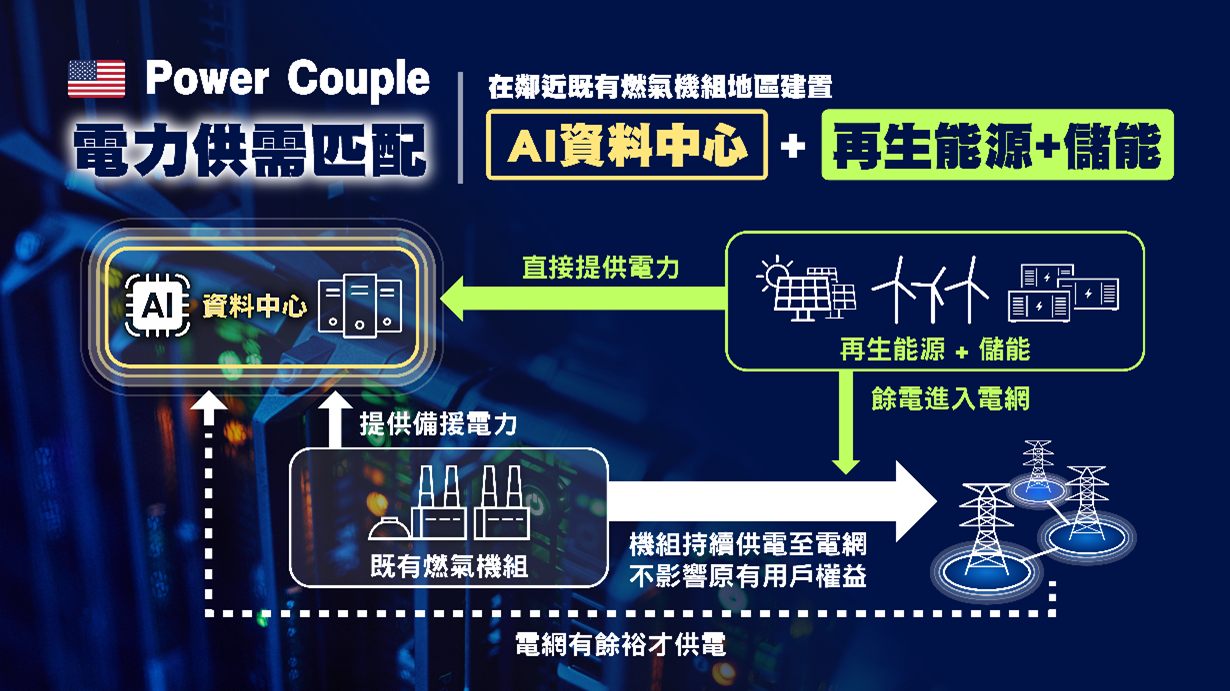
AI data centers are primarily powered by newly built renewable energy sources, while natural gas power plants provide backup power. Natural gas power plants continuously supply power to the grid, without affecting existing users' rights, and only supply power to data centers when the grid has surplus capacity. This avoids consuming additional grid capacity and prevents the transfer of grid upgrade costs to ordinary households and small users.
Currently, the US is also facing the challenge of surging electricity demand from the AI industry and long construction timelines for new power facilities (power plants and grids). There is enormous potential for developing the Power Couple concept near existing natural gas power plants across the US, providing the AI industry with highly competitive and stable low-carbon electricity.
Links: